
It is common for parents to pull their children out of sports practice to squeeze in one more hour of studying before an exam. The pressure on kids in Pune is not imaginary. Board exams are real. Competition for college seats is real. The anxiety that parents carry about their child’s future is completely real.
But there is another perspective to that decision that is lesser known. The importance of sports in a child’s life goes far deeper than most parents realise. The kids who stopped playing didn’t get better grades. They got more anxious. They slept worse. They sat in classrooms but weren’t really there mentally. And the ones who kept playing, even through exam season, somehow held it together better.
It took science a while to explain what educators had quietly noticed for decades. But the explanation is now very solid, and it starts with recognising the importance of sports in a child’s everyday life.
Sports and Physical Health: More Than Just Fitness
Let’s start with the physical side of kids because people tend to neglect it quickly, as if it’s obvious. But it’s worth actually sitting with.
Children are in the middle of their growing stage. Bones are forming. The cardiovascular system is developing. Coordination and motor skills are being wired into the nervous system through repetition and movement. What happens physically during the school years sets patterns that are genuinely hard to undo later, and this is where the importance of sports during childhood becomes impossible to ignore.
According to WHO guidelines on physical activity for children and adolescents, children between ages 5 and 17 need at least 60 minutes of moderate to vigorous physical activity every single day. Not per week. Per day. And most school going children in Indian cities are getting maybe a fraction of that. We have built school schedules, tuition schedules and evening homework routines that have basically engineered movement out of a child’s day like they are robots.
The effects show up in ways parents don’t always connect back to physical inactivity. Poor sleep. Difficulty concentrating in class. Restlessness that gets labelled as a behavioural issue. Low energy that gets mistaken for laziness. A lot of what parents worry about in their children would look very different if those children were getting proper physical activity every day.
And the thing about physical habits is that they stick. A child who grows up moving tends to keep moving. A child who grows up sedentary carries that pattern into adulthood. This is a long game, and most parents don’t think about it that way because they’re focused on the next exam. And that is precisely where the importance of sports gets overlooked.
What Sport Does to the Brain (This Is the Part That Surprises People)
Okay, so this is where the conversation usually shifts.
Because the moment you bring up academics and sports together, you get the familiar argument. Sport takes time. Time spent playing is time not spent studying. More studying equals better results. It makes intuitive sense. But it’s also not what the research shows.
Research documented by Harvard Health Publishing shows that exercise stimulates growth factors in the brain that build new brain cells and strengthen memory. These growth factors also increase the size of the hippocampus. That’s the part of the brain responsible for memory and learning. So exercise isn’t just keeping a child fit. It’s making their brain more capable of doing the exact thing you want it to do in a classroom, and that is what makes the importance of sports so hard to ignore when you look at the evidence.
Dr. John Ratey, a psychiatry professor at Harvard Medical School, wrote an entire book on this called Spark. The most compelling thing he documented was what happened at Naperville Central High School in Illinois when students were asked to exercise before their first class. Reading scores jumped. Academic performance across subjects improved. The school moved up significantly in state rankings. Nobody added more tuition hours. Nobody extended the school day. They just made sure kids were physically active before they sat down to learn.
Multiple studies referenced in the CDC’s report on physical activity and academic achievement show that physically active students tend to get better grades, show up to school more consistently, and demonstrate stronger focus in class than students who aren’t active.
There’s also a simpler reason that sport helps with studies, and it’s one any busy person will recognise immediately. Students who play sport have to manage their time. They have practice schedules, match days, homework deadlines, and rest to balance. That juggling act, done regularly over months and years, builds a discipline and personal accountability that shows up directly in how they approach their academic work. The kids who seem to somehow do everything, sport and studies and everything else, aren’t superhuman. They’ve just learned to manage their time because they had to, and that is one of the quieter proofs of the importance of sports in a student’s life.
The Mental Health Conversation We Keep Avoiding
This is actually the most important section, even though it’s the one people are least comfortable talking about directly.
Student anxiety in India is not a new problem, but it’s a growing one, and it starts younger than most parents want to admit. The combination of academic pressure, social comparison and the particular kind of loneliness that screen dependency creates has produced a generation of children who are often quietly struggling in ways that don’t always show up obviously until something breaks.
Understanding the importance of sports for mental health helps explain why it remains one of the most effective and accessible interventions available to children today.This is not an appeal to ask for more field time, but based on what actually happens chemically in the body during physical activity.
When a child exercises, the body releases endorphins and brings cortisol down. Cortisol is the stress hormone. This isn’t motivational language. It’s biology. A child who plays regularly has a measurably different hormonal environment than one who doesn’t. Anxiety doesn’t vanish, but it becomes more manageable. Sleep improves. The nervous system settles.
But honestly, the mental health benefit to keep an eye on isn’t chemical. It’s experiential.
On a sports field, children fail. They miss catches. They lose matches. They train for something and fall short. And then, without anyone telling them to, they come back the next day and try again. That pattern, experienced over and over in a context where the stakes are real but not catastrophic, builds something that cannot be manufactured any other way. Call it resilience. Call it emotional toughness. Whatever you call it, children who have experienced regular sport have more of it.
This matters enormously when a child encounters difficulty in other areas of life. And they will encounter it. Sport just makes sure they’ve already practised getting back up, and that alone speaks to the importance of sports in building emotional strength in young people.
The Life Skills Nobody Puts on a Report Card
Ask any person who is genuinely good at their job what skills they actually rely on most. You’ll rarely hear specific subject knowledge. You’ll hear communication. Teamwork. The ability to stay calm when things go sideways. Knowing when to trust someone else’s judgment. Knowing when to back yourself.
Sport teaches all of this. Not in a classroom, not through instruction, but through actually doing it when something is at stake.This is perhaps where the importance of sports shows up most honestly in a child’s life.
A child playing football for two years has made thousands of real-time decisions under pressure. They’ve had to trust teammates they didn’t always agree with. They’ve had to adapt when a plan stopped working. These experiences build something real. The Aspen Institute’s Project Play research on youth sports and life skills found that children consistently involved in organised sport developed significantly stronger resilience, emotional regulation and social skills than those who weren’t, and these qualities stayed with them well beyond their playing years.
It’s also worth making a distinction here between what team sports build and what individual sports build, because they’re genuinely different things and both matter.
Team sports, think cricket, football, basketball and kabaddi, teach a child to function as part of a group. To win together and lose together. To communicate when it’s uncomfortable. To put something shared above their own preferences. These are the skills that determine how people function in workplaces and in relationships.
Individual sports teach something else. When you’re swimming a race or running an athletics event, there’s nobody else to lean on. The competition is essentially with your own previous best. The discipline to keep training when results come slowly, to push past the point where it feels pointless, to show up for yourself without external pressure, that’s a different muscle entirely. And children who develop it carry it everywhere.
What a Real School Sports Program Should Look Like
This is something parents don’t ask about enough when they’re choosing a school, and that is because they don’t quite know what to ask.
Most schools have sports. But there’s a big difference between a school that holds a sports day in January and a school that takes sport seriously as part of a child’s weekly life. A school that genuinely values the importance of sports knows that the outcomes for children are not the same. Not even close.
A well-built school sports program offers variety. It has structured team sports that run through the year, not just in season. It has individual sports for children who don’t thrive in group settings. And increasingly, schools that genuinely understand child development are including martial arts in their programs.
Taekwondo tends to get a raised eyebrow from parents who haven’t seen it taught well. The assumption is that it’s about fighting or aggression. It’s the opposite. A good taekwondo program for children is one of the most structured, focused and emotionally grounding activities available. A peer-reviewed study on taekwondo training and cognitive function in adolescents followed participants through 18 months of taekwondo training and found significant improvements in attentional control and cognitive function compared to a control group. For children who struggle with focus, impulsivity or low confidence, the changes are often visible to parents quite quickly.
There’s a particular kind of confidence that martial arts builds. It’s quieter than the loud confidence you sometimes see in team sport contexts. It comes from a child knowing, through real experience, that they can face something that intimidates them and manage it. Once that belief is established, it tends to show up everywhere else in a child’s life.
What We Do at Sanskriti School, Pune
Sport at Sanskriti is not a break from education. It is part of education.
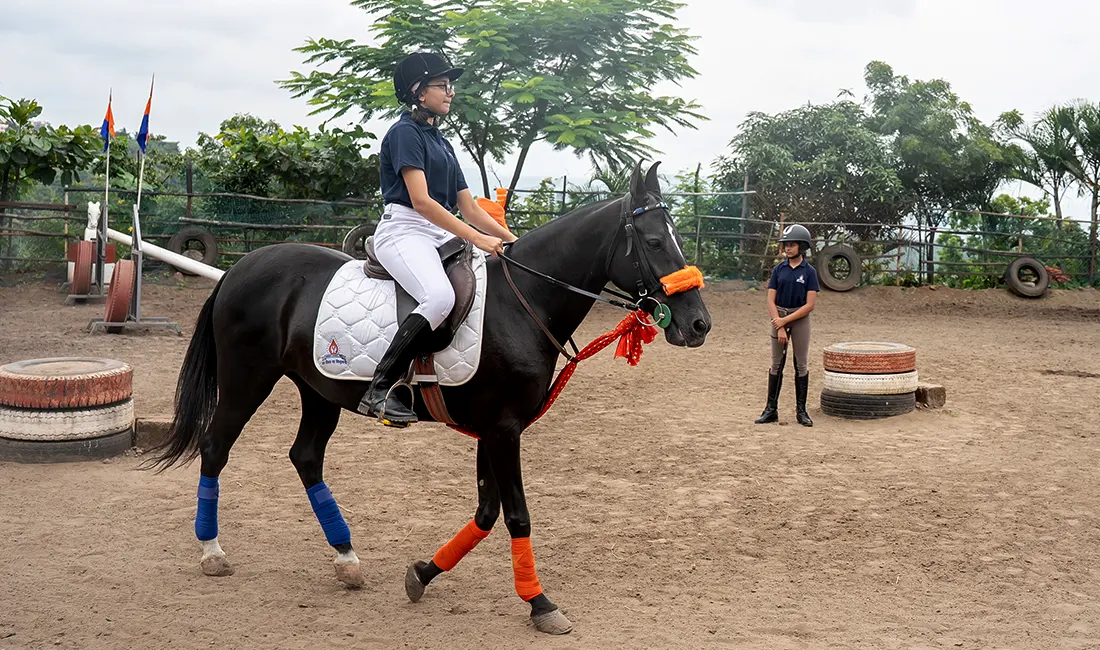
Our students have structured cricket, football and basketball programs that run as part of the regular weekly timetable. Athletics runs through the year. We include yoga alongside competitive sport because some children need movement that is quieter and more focused, and that matters too. And our taekwondo program, run by instructors who genuinely understand what they’re building in these children, has become something we’re quietly very proud of.
What we’ve seen over the years is not dramatic. It’s steady. Children who came in hesitant and avoidant gradually becoming more willing to try hard things. Children who were physically restless finding a structured outlet that helped them sit more calmly in class. Children who had never experienced the particular satisfaction of getting better at something difficult finding it on the mat or on the field.
If you’re a parent looking at schools in Pune, ask about the sports program specifically. Ask what happens on a regular Wednesday, not just on sports day. Ask whether coaches are trained to work with children as people or whether sport is just supervised activity. Ask whether sport is talked about as part of the school’s actual philosophy. The answers will tell you more than the prospectus will.
To Wrap Up
The importance of sports in a student’s life isn’t really a separate conversation from academics. It’s the same conversation.
A child who plays regularly learns better, manages stress better, sleeps better and handles failure better than one who doesn’t. Their social skills are sharper. Their sense of personal capability is stronger. The habits they form around effort and recovery will serve them in contexts none of us can predict yet.
Sport isn’t something children do when the real work is done. For many of them, it is some of the most important work they will do during their school years.
Common Questions
When should children start playing organised sport?
Movement based play can start from age 4 or 5. Organised sport with structure and coaching tends to work well from age 6 or 7, when a child has enough coordination and social readiness to benefit from it.
How much physical activity do children actually need?
The World Health Organisation recommends a minimum of 60 minutes of moderate to vigorous physical activity every day for children aged 5 to 17. This doesn’t have to be in one block. It can be spread across free play, PE class and after school sport.
Will sport take time away from studies?
The research says the opposite is true. Once you understand the importance of sports for concentration, memory and sleep, it becomes clear why students who are regularly active tend to perform better academically than those who are not.
Is martial arts suitable for children?
Very much so, when it’s taught well. A proper martial arts program for children is built around discipline, respect, focus and self-confidence. Parents regularly notice meaningful changes in their child’s behaviour and attention span within a few months of starting. It has nothing to do with aggression.
What should I look for in a school’s sports program?
Consistency matters more than anything else. Sport that happens every week, with proper coaching, for children at all ability levels, is fundamentally different from sport that appears on the school calendar twice a year. Ask about the regular week, not the highlight reel.