
There is a particular kind of parenting guilt that hits at around 11pm at night.
You have just read something about childhood development, or watched a reel about screen time, or heard another parent mention how their child wakes up at six and journals before school. And you are lying there wondering if you have already missed the window. If the habits are already set. Is it too late for a course-correction?
It is not. But the reason most parents feel this way is that nobody has ever properly explained what good habits for kids actually do inside a child. Not the surface-level stuff. The mechanism. The real reason a child who reads for pleasure at nine is measurably different from one who does not. The actual neuroscience behind why breakfast at seven in the morning changes what happens in a classroom at eleven.
That is what this is about.
I have worked with children in Pune across different schools, backgrounds, and family situations for years. The children who handle pressure well, who recover from setbacks, who sit in classrooms and actually absorb what is happening around them, are not exceptional children. They are children with ordinary lives and consistent habits. This piece is for parents who want the real explanation, not the list. And for students who need a genuinely researched piece on good habits for students in school. Both audiences will find what they came for.
What Most People Get Wrong About Good Habits for Kids
Here is the thing about every article on good habits for children that has ever been written. They all end up in the same place. Wake up early. Brush teeth. Read. Exercise. Eat breakfast.
Nobody disputes any of that. The problem is that knowing a habit is good and actually building it in a living, breathing, sometimes-screaming child are two entirely different challenges. And the gap between them is almost always about understanding why.
When you genuinely understand why your child needs nine hours of sleep, not just that they need it, the bedtime conversation changes. You stop negotiating. When you understand what skipping breakfast actually does to a developing brain by mid-morning, the rushed Tuesday excuse starts to lose its hold.
So for each of the 10 good habits for students and children in this piece, you will get the mechanism. The research. And one specific, honest thing you can do today. Not a system. Not a challenge. One thing.
Habit 1: Reading Every Day — But Not the Way You Think
Most reading habits in most homes look like this. The child comes back from school. The parent says twenty minutes of reading. The child opens the assigned book. Reads with roughly the same enthusiasm as someone filling out a tax form. Clock runs out. Done.
That is not a reading habit. That is a chore wearing a reading habit’s clothes.
What actually changes a child is reading for pleasure. Their choice, their pace, their genre, no interruptions. Researchers from Cambridge, Warwick, and Fudan University followed over 10,000 children and found that kids who read for pleasure from as young as two showed significantly stronger cognitive performance, better memory, improved mental health, and measurably different brain structure by adolescence. Twelve hours of self-chosen reading per week was where the biggest gains showed up.
The UCL Institute of Education tracked 6,000 children from the 1970 British Cohort Study through their entire childhood. What they found sits with you once you read it. Reading for pleasure between ages 10 and 16 had more influence on a child’s cognitive development than whether their parents had a university education. Reading regularly, using the library, picking up a newspaper at 16. The combined weight of those behaviours was four times more powerful than having a degree-holding parent at home.
Four times.
Reading is one of the most powerful good habits for kids on this entire list. But it only works when the child owns the choice.
What you can do today: Go to a bookshop or library this weekend and let your child pick anything at all. Do not steer toward educational value. Do not comment on their choice. The only goal is that they chose it and they want to go back to it tomorrow.
Habit 2: Eating a Healthy Breakfast Every Single Morning
Every parent already knows breakfast matters. The problem is that on a rushed Wednesday morning when the uniform still needs ironing and someone cannot find their water bottle, knowing it matters and actually making it happen are different things.
Here is the specific detail that tends to change that.
University of Leeds researchers published a study in Frontiers in Public Health showing that habitual breakfast consumption was consistently and positively linked to academic performance in adolescents. Not occasionally linked. Consistently. A separate review in PubMed that pulled together 36 different studies found clear evidence that eating breakfast improves in-class behaviour, concentration, and sustained attention through the morning.
The brain accounts for roughly 20 percent of the body’s total energy use.A child who skips breakfast is running their brain on yesterday’s fuel. By mid-morning their concentration is unreliable, their emotional regulation is shaky, and their ability to form new memories is compromised. They are physically present in class but operating well below what they are capable of.
And this is genuinely one of those good habits for children that requires almost no money and very little time.
What you can do today: It does not need to look like anything impressive. A banana and milk. Leftover poha reheated in four minutes. A paratha can be eaten standing at the counter. The habit is more important than the meal. Start with something.
Habit 3: Managing Screen Time With Intention
Almost every parent has a complicated relationship with this one. Strict rules feel impossible to enforce. Complete openness feels irresponsible. Most families are living somewhere in the uncomfortable middle, vaguely aware that it is not quite right but unsure where the actual line is.
The case against screens is not that they are inherently harmful. It is that unmanaged, they displace things that are.
A large study published in Nature Human Behaviour found that excessive screen time was positively linked to anxiety and depression in children and adolescents. The connection worked primarily through two paths: disrupted sleep and reduced physical activity. A separate prospective analysis from the Adolescent Brain Cognitive Development Study at UCSF found similar results connecting heavy screen use to mental health difficulties in young people.
Four hours on a screen is four hours that did not go toward reading, moving, talking to someone face-to-face, making something, or sleeping. Each of those things does something irreplaceable for a developing child. Passive screen time does not.
Good habits for kids around screens come down to one question: is this use intentional or is it just filling space?
What you can do today: Choose one window in your home and make it screen-free. The dinner table. The 45 minutes before bed. Just one. Hold it consistently for two weeks. That is a more meaningful change than any app-based restriction.
Habit 4: Daily Physical Activity — Even Twenty Minutes Counts
The World Health Organisation recommends at least 60 minutes of moderate to vigorous physical activity every day for children aged 5 to 17. Walk through most residential areas in Pune after school hours and you will see children inside, screens on, and that recommendation quietly going unmet.
This is precisely where the importance of sport stops being a PE class concern and becomes a brain development concern.
Harvard Health Publishing has documented research showing that physical exercise triggers the release of brain growth factors that build new cells, strengthen neural connections, and increase the size of the hippocampus. That is the structure in the brain most directly responsible for memory and learning. A child who moves regularly is not just fitter. They are building a more capable brain while they run around.
Sleep quality improves with regular movement. Stress response improves. Anxiety levels drop measurably. The importance of sport is not separate from academic performance. It is underneath it.
None of this requires a gym membership or a structured programme.
What you can do today: Walk with your child for twenty minutes after dinner tonight. Not a sport, not a drill. Just movement. That is enough to start.
Habit 5: Helping with Household Chores
This is the habit parents resist most. The logic feels obvious: school is demanding, children are tired, chores feel like one more thing being piled onto an already full plate.
The research makes a strong argument the other way.
The Harvard Study of Adult Development ran for over 85 years, making it the longest study of human development ever conducted. It found that children who were given real household responsibilities grew into adults with stronger relationships, better work ethic, more resilience, and higher reported life satisfaction. Researcher Marty Rossman at the University of Mississippi identified something sharper still. The single strongest predictor of how well a young adult was doing in their mid-twenties was not their grades or their school. It was whether they had done household chores as young as three or four years old.
That is a striking finding. Worth sitting with.
What chores teach is not how to sweep a floor. It is that contribution is expected. That effort is real. Those tasks have weight and completion has satisfaction. Dr. Julie Lythcott-Haims, who spent years as Dean of Freshmen at Stanford, found that students who grew up with household responsibilities adapted to an independent life better, struggled less, and showed more consistent capability under pressure.
This is one of those good habits for children that costs nothing and gives back everything.
What you can do today: Give your child one non-negotiable, age-appropriate task this week. Pack their own bag. Clear their plate. Water one plant. Let them own it completely, even if they do it imperfectly. Do not redo it.
Habit 6: Practising Gratitude
Stay with me on this one.
Michigan State University Extension, drawing on a substantial body of research, found that children who practised gratitude regularly showed genuine increases in alertness and motivation. They made more consistent progress toward their own goals. They slept better and reported starting their days feeling more rested.
A 28-week study published in the Early Childhood Education Journal by Springer Nature ran a structured gratitude practice with first-grade children and measured significant, positive changes in their wellbeing across the duration.
Here is the mechanism that actually matters. Gratitude trains attention. A child who is regularly asked to notice what went well in their day is building a brain that looks for evidence of good things rather than defaulting to threat-scanning. In an environment that constantly pushes comparison and inadequacy at children through screens, friends, and academic pressure, this is not a soft skill. It is a genuine psychological protection.
It does not make children naive about difficulty. It makes them more capable of recovering from it.
What you can do today: Before your child sleeps tonight, ask them to name three things from the day that were good. Anything counts. Do it out loud yourself too. Two minutes. The effect is quiet at first and then one day you notice your child doing it without being asked.
Habit 7: Getting Enough Sleep
Most parents believe sleep matters. Fewer parents actually protect it on a Tuesday night when homework runs late and everyone is tired and irritable and it feels easier to just let another thirty minutes slide.
Research published in Nature Human Behaviour found that sleep deprivation in children and adolescents was directly linked to weaker academic performance, emotional instability, slower cognitive processing, and meaningfully higher risk of depression and anxiety. One poor night affects the brain’s ability to consolidate learning from the day before. Not over time. That same night.
The Sleep Foundation documents consistent associations between insufficient sleep and higher rates of behavioural problems in classrooms, impaired decision-making, increased aggression, and persistent low energy that parents often misread as laziness or attitude.
Here is what most families do not see clearly. Late screen time breaks sleep. Broken sleep damages mood and concentration. Damaged mood leads back to screens for comfort and stimulation. The cycle runs quietly in the background for months. Nobody connects it because the screen is visible and the exhaustion underneath it is not. Due to this, children become impulsive and develop a short temper that feels like a personality trait when it is actually a sleep problem.
Children aged 6 to 13 need 9 to 11 hours. Teenagers need 8 to 10. Most Indian school-going children are getting less than either.
What you can do today: Push bedtime 15 minutes earlier this week. Not an hour, just 15 minutes. Take screens out of the bedroom. Those two changes produce results within days.
Habit 8: Following a Morning Routine
You already know this morning. Alarm ignored twice. The child eventually dragged upright. One shoe is missing. Argument about what goes inside the lunchbox. Uniform located at the last possible second. The goodbye happens at a run and everyone arrives at their destination already behind.
That chaos is not just unpleasant. It disrupts your child’s day before it even starts.
The American Academy of Pediatrics has documented that consistent daily routines reduce anxiety in children, build self-regulation, and create the kind of psychological steadiness that lets children cope with stress across the rest of the day. A child who leaves the house flustered arrives at school carrying that flustered feeling into the first period. It does not just disappear at the school gate.
The routine itself does not need to be elaborate or military. It needs to be predictable. The same order every day, automatic enough that the child’s brain is not spending energy deciding what happens next. Breakfast lives inside that routine. Hygiene lives there. Even a few quiet minutes of reading before everything starts is entirely realistic when the structure already exists.
What you can do today: Sit with your child and write out the morning sequence together, letting them have real input on the order. Stick it somewhere visible. Two weeks of consistent practice is usually enough for it to start running on its own.
Habit 9: Personal Hygiene as a Daily Practice
There is a real difference between a child who washes their hands because a parent is standing nearby and a child who does it because they have made it their own standard. Both produce clean hands in the short term. Only one of them works when nobody is watching.
WHO guidelines and NHS guidance are unambiguous on this. Consistent hygiene habits, particularly handwashing, dental care, and basic grooming, significantly reduce illness, improve self-esteem, and cut school absenteeism. Children who are taught these as values rather than tasks are far more likely to maintain them independently as they get older.
There is a social reality here that does not come up enough. Children are remarkably perceptive about each other. A child who arrives clean and cared-for moves through social interactions with an ease and baseline confidence that is immediately visible. This seems like a small thing. Across years of school life, it is not small at all.
What you can do today: Stop reminding. Start explaining. Next time your child washes their hands, show them the technique and explain why it matters. Keep it conversational, not instructional. Children who understand the reason behind something are far more likely to own it.
Habit 10: Good Manners and Respectful Communication
This is the last of our 10 good habits for students. It is also the one with the longest reach. It defines your child in rooms you will never be in.
Researchers at the Harvard Graduate School of Education studied what children across thousands of families said they actually wanted for themselves. The finding surprised many people. Children consistently said they wanted to be raised to be kind. Not just capable or successful. Kind. And they also reported, consistently, that the adults around them were sending the opposite signal without knowing it. The way children communicate shapes their behaviour, their relationships, and how others receive them across every stage of life.
Good manners are the daily, unremarkable practice of that kindness. Saying thank you. Looking at someone when they speak to you. Letting someone finish their sentence. Acknowledging the person who holds the door.
Apologising like you mean it. None of these are formalities. They are emotional intelligence expressed in ordinary moments, and they shape every relationship your child will ever have.
What goes unsaid about manners most of the time is where they actually come from. Not from being told. From watching. Your child is watching how you speak to waitstaff, how you behave when you are kept waiting, how you handle being wrong. All of it is being absorbed, all the time.
What you can do today: Think of one moment today where you behaved exactly the way you want your child to behave. If you cannot find one, that is the most useful thing this article has told you.
How Sanskriti School Builds Good Habits for Students in School
At Sanskriti School, good habits for students in school are woven into the curriculum itself, not treated as something separate from learning.
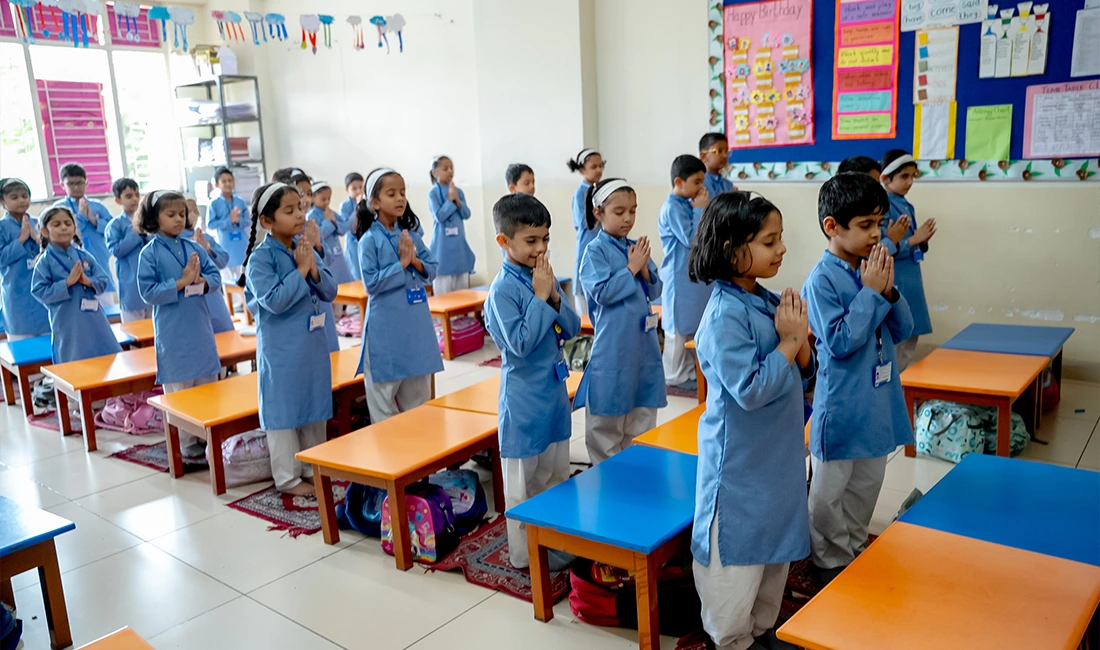
The school day starts with a structure that children can predict and rely on. Physical activity is part of every day, not only PE periods. The library is a regular destination, not a reward. Children are expected to contribute to their shared spaces, to acknowledge each other and their teachers, and to take care of things that belong to the group. These are not rules enforced from outside. They are rituals of the community, repeated until they become instinct.
We talk openly with parents about the connection between home habits and what teachers see in the classroom, because the link is real and visible. A child who sleeps well arrives differently. A child who ate breakfast before school sits differently. A child who carries genuine responsibility at home walks in with a quiet steadiness that experienced teachers recognise immediately.
Good habits for children are a shared project between school and family. The school can reinforce them every day. But the foundation comes from home, from small consistent moments, from the people a child watches most closely and trusts most deeply.
A Final Word to Parents
You are not trying to produce a perfect child. That is not the goal and it was never the goal. You are trying to give a real child the internal resources to handle a world that will not always be fair or kind or predictable.
These 10 good habits for kids are those resources. None of them are expensive. None of them require more hours in the day than you already have. They require you to be consistent, and they require you to be honest with yourself about what you are actually modelling.
Pick one habit. Build it until it does not need your attention anymore. Then pick another. That is genuinely how good habits for kids are built. Not in a grand plan made on a Sunday. On a Tuesday. And the next Tuesday. And eventually, quietly, in a child who becomes someone you did not entirely plan for and are glad you got.
Frequently Asked Questions
What are good habits for kids that have the most impact?
The ones with the strongest evidence behind them are reading for pleasure, consistent sleep, daily physical movement, intentional screen management, and giving children real household responsibility. These are the good habits for children that show up most consistently across decades of research on child development.
What are 5 good habits for kids that parents can start building this week?
A consistent wake-up and bedtime, breakfast every morning without exception, twenty minutes of physical activity after school, a screen-free dinner table, and three good things named out loud before sleep. Every one of these is small enough to start tonight.
How do good habits for students in school get built effectively?
The home and the school have to be working in the same direction. At home, routine and consistency do most of the work. At school, habits form through repetition, teacher modelling, and a culture that genuinely values contribution and responsibility. Schools that treat character as curriculum rather than an add-on tend to produce students who carry these behaviours long after the school day ends.
At what age should children start developing good habits?
Earlier produces stronger outcomes. The Harvard research found that children who began contributing to household tasks as young as three showed the most positive long-term results. Reading habits form most naturally between ages two and nine. The earlier good habits for children are introduced, the more completely they become part of who the child simply is.
What is the difference between good habits and rules for kids?
Rules live outside the child. Habits live inside. A child following a rule is complying because something external is requiring it. A child who has built a habit is acting from their own identity. The goal of building good habits for kids is not to produce children who behave well when watched. It is to raise people who behave well when nobody is watching.
Do good habits really affect academic performance in students?
Yes, directly and significantly. Sleep, breakfast, physical activity, and reading for pleasure all have robust, well-replicated effects on memory, concentration, cognitive processing, and academic output. Good habits for students are not a soft complement to academic work. They are the foundation without which academic work becomes much harder than it needs to be.