
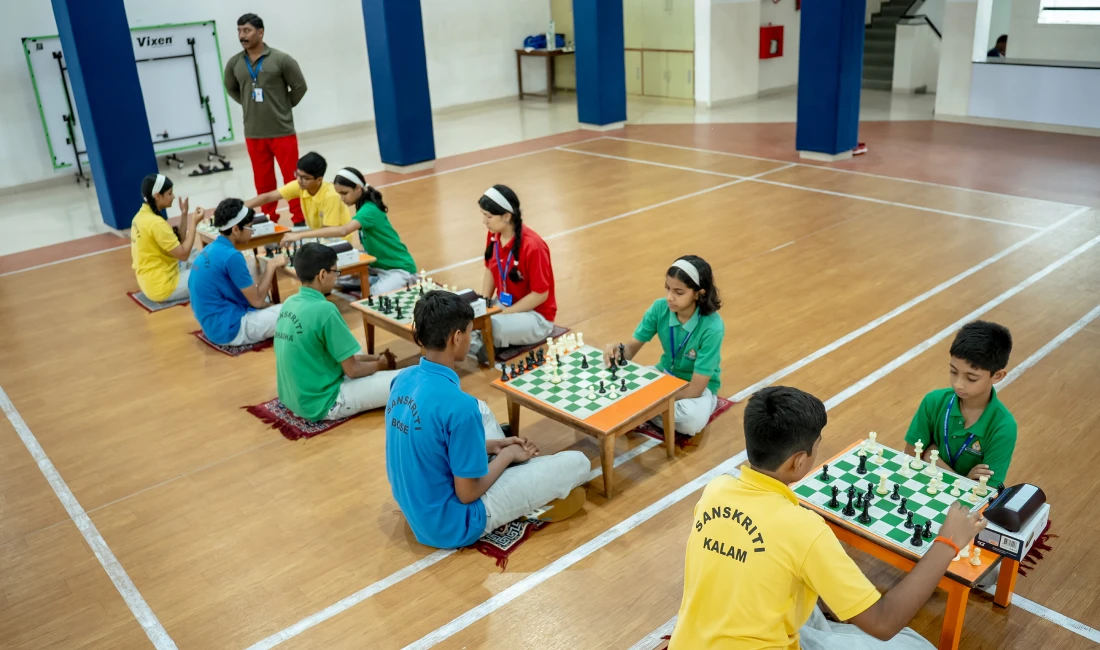
Think about the things children remember from school. It may be a favourite teacher, a school trip, a funny moment with friends, or a game they played during a break.
Not every important lesson happens in a classroom.
Sometimes, it happens around a chessboard. Sometimes, during a close game of table tennis. Sometimes, a child learns something about themselves simply by losing a match, trying again, and doing a little better the next time.
This is one reason indoor games for students deserve a place in school life.
Games give children time to think, interact, compete and, importantly, have fun. While they are playing, they are also learning how to make decisions, deal with disappointment, communicate with others and stay focused on what they are doing.
At Sanskriti School Pune, activities beyond academics form an important part of a child’s school experience. The aim is not to turn every student into a sportsperson. It is to give children opportunities to discover what they enjoy and learn through experiences outside their regular lessons.This approach also connects with the wider learning through play approach recognised in child development.
Why Are Indoor Games Important for Students?
A game may seem simple from the outside. Take chess, for example. Two students sit across a board and move pieces. But behind every move, there is thought, observation and a decision.
The same is true of other indoor games.
Carrom asks a child to concentrate and judge a shot. Table tennis demands quick reactions. Badminton requires movement as well as awareness of what the other player is doing.
Children are not necessarily thinking, “I am developing my concentration right now.” They are simply playing.
And that is what makes games so useful.
Learning happens naturally when children are interested in what they are doing.
For a broader perspective on how sports contribute to a child’s development, parents can also explore the importance of sports in students’ life.
5 Benefits of Indoor Games for Students
1. They Help Children Become More Confident
Confidence usually comes from doing something, not simply being told that you can do it.
Imagine a student who is new to chess. The first few games may not go their way.
Gradually, they understand the rules, recognise patterns and start making better moves.
That first win can mean a lot.
It tells the child that practice makes a difference.
The same thing happens with badminton, table tennis, carrom or any other game. Small improvements give children a reason to believe in their own abilities.
That confidence can eventually show up elsewhere too — when answering a question in class, joining a group activity or trying something they have never done before.
Play can also give children opportunities to build confidence and resilience while interacting and learning with others.
2. Games Teach Children How to Work Together
Some lessons about teamwork are difficult to teach through a textbook.
Games make them much easier to understand.
In a doubles badminton match, for instance, both players have to pay attention to each other. They have to communicate, cover space and make decisions together.
Sometimes one player performs better than the other. Sometimes both make mistakes.
They still have to continue playing as a team.
These experiences help children understand that working with others requires patience, communication and trust.
3. Losing Teaches a Valuable Lesson
Every parent wants their child to succeed. But children also need to learn how to deal with things not going their way.
A game provides a relatively safe place to learn this.
You lose a chess match. You miss an easy shot. Your opponent scores the final point.
It can be disappointing.
But the game also gives you another chance.
Children begin to understand that one bad result does not define them. They can look at what happened, practise and try again.
That is an important lesson to carry into academics, friendships and later life.
4. Indoor Games Improve Focus
Many children today are surrounded by distractions. Keeping their attention on one activity can sometimes be difficult.
Games give them a reason to concentrate.
A chess player has to watch the board. A carrom player has to judge the angle before taking a shot. A table tennis player needs to follow the ball and react almost immediately.
This kind of focused attention develops through practice.
It is one of the quieter benefits of indoor games, but an important one.
Parents can also find practical ideas on how to focus on studies, especially when children find it difficult to stay away from distractions.
5. They Give Children a Break From Routine
School days can be busy.
There are classes, assignments, tests and deadlines. Children need opportunities to step away from academic pressure for a while.
Playing a game provides that change of pace.
And unlike simply spending time on a screen, playing with another person creates interaction. Children talk, laugh, compete and sometimes argue about the rules — all part of learning how to be around other people.
Which Indoor Games Can Students Play?
There is no single “best indoor game” for every child.
Different games appeal to different personalities.
- Chess can be a great choice for children who enjoy strategy and thinking several moves ahead.
- Carrom combines concentration with hand-eye coordination.
- Table tennis requires quick reactions and constant attention.
- Badminton brings movement into an indoor setting and can be played individually or with a partner.
- Board games introduce children to planning, rules, turn-taking and decision-making.
The important thing is not which game a child chooses. It is that they get the opportunity to play, experiment and find something they genuinely enjoy.
Indoor Games and Life Skills
The value of games becomes clearer when we look beyond the game itself.
- A child playing chess is learning to think before making a decision.
- A child playing doubles badminton is learning to communicate.
- A student who loses a match is learning how to handle disappointment.
- A student who keeps practising is learning patience.
None of these lessons need to be announced. They happen while the child is involved in the activity.
This is why indoor games for kids and students can be such a meaningful part of school life.
What Parents Should Look For in a School
When choosing a school, academics will naturally be high on every parent’s list. But it is worth looking at what happens between the lessons as well.
Does the school give children opportunities to participate in sports and activities?
Are students encouraged to try something new?
Is participation valued alongside achievement?
Do children get opportunities to work with their peers?
These questions tell you something about the kind of school experience your child will have.
At Sanskriti School Pune, sports and extracurricular activities are part of the wider learning environment, alongside academics.
The idea is simple: children need different experiences while growing up. Some will discover a passion for sport.
Others may find that they enjoy strategy games. Some may simply enjoy spending time with friends.
All of those experiences have value.
More Than Just a Game
A chessboard does not look like a classroom.
A carrom board does not look like a lesson plan.
Yet children can learn a great deal from both.
They learn to wait, think, decide, communicate and try again. They learn that sometimes you win and sometimes someone else does. They learn that improvement rarely happens in one attempt.
These are small lessons, but they add up.
At Sanskriti School Pune, the goal is to give children an education that includes more than what they read in textbooks. Indoor games are one of the many ways students can explore their abilities, interact with others and become more comfortable taking on challenges.
Because years from now, a child may not remember every game they played at school.
But they may remember the confidence they gained from finally winning one.
They may remember the friend they played with every afternoon.
Or they may remember losing, coming back the next day, and trying again.
That is where the real value of a game lies.