
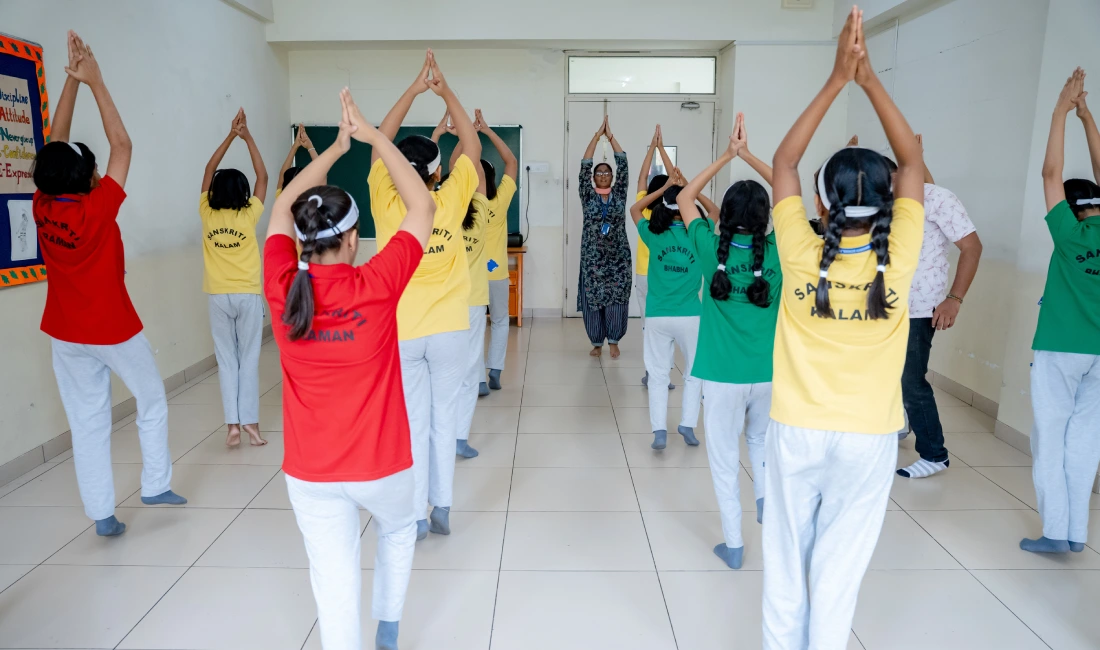
Maybe. Not a cure, though. A few small studies link yoga with less anxiety, better moods or more self-control in kids, but others find nothing much, and some of them are pretty shaky. So think of yoga for anxiety as one gentle tool, not a treatment. If your child is really struggling, a doctor or child psychologist comes first. What yoga can do is give a worried kid something calm and physical to do with all that tension.
Why so many parents are asking
Picture it. Your child won’t let go of your hand at the school gate. Or it’s the night before a test and suddenly their tummy hurts. Or dinner is different from what they expected and the whole evening falls apart. A bit of worry is normal. When it starts to affect sleep, school or play, though, you want answers, and somewhere along the way someone says “try yoga.”
We wanted to know if that advice holds up. So here’s what the research on yoga for anxiety in children says, what it doesn’t say, and a few things you can try at home tonight. We’re the teachers at Sanskriti School Undri in Pune, not doctors, and this is written with kids aged roughly 3 to 10 in mind. Please don’t take it as medical advice.
What anxiety can look like in young children
Very few children will tell you “I feel anxious.” They show it. Look out for tummy aches and headaches on school mornings, clinging, bad sleep or sudden nightmares, and tears or tantrums that seem far too big for what set them off. Some kids stop doing things they used to love, like parties or speaking up in class. Others ask “but what if…?” about everything. These are the common signs of anxiety in kids.
Any one of those can be ordinary childhood. What counts is how long it lasts and how much it gets in the way. School is a big trigger on its own: new classrooms, exams, friendships, the morning rush. The NHS has a good parent guide to anxiety in children if you want more. Not sure whether to worry? Jump ahead to the section on when to see a doctor.
What does the research say about yoga for anxiety in children?
| Study | Who was studied | What it found | The catch |
|---|---|---|---|
| Ferreira-Vorkapic et al., 2015, a review of 9 randomized trials of school-based yoga | School-age children and teenagers | Yoga groups did better than comparison groups on mood, tension and anxiety, self-esteem and memory | The overall combined effect was not significant, a few studies found negative effects, and the authors called the evidence inconclusive |
| James-Palmer et al., 2020, a systematic review | Children and adolescents | Many studies showed some drop in anxiety, depression or both | The studies were of weak to moderate quality |
| Razza et al., 2015 | 29 children aged 3 to 5, over a full school year | Teacher-led mindful yoga was linked to better attention, delaying gratification and impulse control | Very small, and not a fully randomized trial |
| University of Michigan thesis, 2022 | Nine preschool classrooms | Better balance and interpersonal skills in the yoga group | No clear change in classroom behaviour |
| Bilkent University thesis, 2019 | 45 preschoolers doing yoga twice a week for 12 weeks | Better working memory, and mothers rated the yoga group as happier | Teachers saw no difference between the groups |
A word of caution. None of this proves yoga cures anxiety. Several of the preschool studies looked at attention and self-control, which are cousins of anxiety, not the same thing. In a few school studies, kids in the yoga group actually felt more stressed, and the reviewers guessed it was because something new takes getting used to. Add the fact that programmes differ in style, length and teacher, and you can’t say much about any one child.
Our view as teachers? It’s worth a try, it’s gentle, and it’s too early to promise anything. If it helps, great. If not, you haven’t lost much.
How might yoga for anxiety help?
Why might it help? Honestly, researchers are still debating that, and nothing below is proven for young children. Slow breathing is the usual suspect: a long breath out tells the body it can settle, and early work in young people points to the body’s stress response as one possible route (James-Palmer et al., 2020). Yoga also makes kids notice their bodies, the tight chest or hot face that comes before a wobble. In the Michigan preschool study, the children who started out with less body awareness gained the most self-control (source). Then there’s the simple stuff. The same few poses in the same order feel safe on a shaky day, and stretching burns off restless energy.
Calming poses and breathing exercises for kids
| Practice | How to do it | Why children like it |
|---|---|---|
| Child's pose (Balasana) | Kneel, sit back on the heels, fold forward and rest the forehead on the floor. Arms by the sides or stretched out | It feels like a little hiding den |
| Cat-cow (Marjaryasana-Bitilasana) | On hands and knees, round the back like an angry cat, then dip it like a cow. Breathe out on the cat, in on the cow | Making animal sounds is encouraged |
| Tree pose (Vrikshasana) | Stand on one foot, the other foot resting on the ankle or calf. Arms up like branches. Hold a wall if needed | Wobbling is allowed, and it builds focus |
| Butterfly (Baddha Konasana) | Sit with the soles of the feet together and flap the knees slowly | It's a gentle hip stretch that feels like a game |
| Belly breathing with a soft toy | Lie down with a soft toy on the tummy. Breathe in so the toy rises, breathe out so it sinks | The toy gives a clear way to see the breath |
Two breathing exercises for kids that feel like games: bumblebee breath (breathe in through the nose and hum like a bee on the way out, so the out-breath gets long without anyone counting) and smell the flower, blow the candle (slow breath in through the nose, long gentle breath out through pursed lips, which suits the littlest ones best).
Fancy a quiet minute of meditation for kids at the end? Keep it tiny. Eyes closed, name three sounds you can hear. For under-6s, that’s more than enough.
A 5-minute calm-down routine for home
Try this before school, after school or at bedtime, whichever fits your day. Do it with your child, since kids copy what they see. Dim the lights and switch off screens if you can.
- Arrive (30 seconds). Sit together and ask, “Where do you feel your body today? Tight, wobbly, or calm?” There are no wrong answers.
- Belly breathing (1 minute). Soft toy on the tummy, five slow breaths.
- Cat-cow (1 minute). Five rounds, with sounds.
- Tree pose (1 minute). Thirty seconds on each leg. Wobbling is fine.
- Child’s pose (1 minute). Rest and take three bumblebee breaths.
- Quiet minute (30 seconds). Lie still and name three sounds.
Same time every day helps. Praise the trying, not the pose. And if your child flat-out refuses, let it go for that day, because a routine that feels like a chore calms nobody. For school-morning nerves, this plus the same calm goodbye every morning usually beats trying to talk a worried child out of their feelings.
Yoga, movement and school: what to look for
If you’re choosing a school or preschool and movement matters to you, these questions will tell you more than a brochure. Our checklist for choosing the right school covers the wider questions too.
- Who leads the sessions, and what training do they have?
- Are the activities play-based and suited to the child’s age, with no pushing into stretches?
- Is the practice regular, or only a one-off event?
- Can a child opt out or rest without being made to feel odd about it?
- How does the school help a nervous child settle in, and how does it speak with parents about worries?
- Is the space safe, supervised and calm?
How movement fits in at Sanskriti School Undri
Sanskriti School Undri is on NIBM Link Road and runs a CBSE programme from Pre Primary to Class X. Our fitness programme, which was designed with input from the Indian Armed Forces, starts in Pre Primary. Pre Primary runs Monday to Friday, 9:15 AM to 12:45 PM, and daycare runs Monday to Saturday, 12:30 PM to 6:30 PM for families who need longer hours. We also have campuses in Bhukum and Wagholi.
For an anxious child, feeling safe matters as much as the activity. The campus has CCTV, police-verified staff, security led by retired military and police personnel, and GPS-tracked buses.
Looking at preschools in the area? Our guide to what to look for in a preschool in Undri covers safety, the daily routine and admission age.
Open question for the school team: add one or two lines on how yoga, breathing or mindfulness is used in the daily routine (who leads it, how often, from which class). Leave this out if it isn’t part of the programme.
Want to see the place and meet the teachers? Visit the Undri campus page, read about the admission process, or contact us. You can also call 9272223402 or 7719048003, or write to admissions@sanskritischoolpune.in.
When to talk to a doctor or child psychologist
Yoga is a support, not a substitute for care. Please talk to your paediatrician or a child psychologist if:
- The worry has lasted several weeks and isn’t easing
- It disrupts sleep, eating, school attendance or friendships
- Your child has frequent stomach aches, headaches or panic-like episodes with no clear medical cause
- Your child refuses to go to school most days
- Your child talks about hurting themselves or says they feel hopeless. In that case, seek help the same day
A check-up with your paediatrician is a good first step, since they can rule out physical causes and point you to the right specialist. The American Academy of Child and Adolescent Psychiatry has a parent-friendly anxiety resource center. And if you need to talk to someone quickly, India’s free, 24/7 Tele-MANAS helpline is on 14416 or 1800-89-14416, in the language of your choice.
Frequently asked questions
Can yoga cure anxiety in children?
No. Studies suggest it may help some kids feel calmer, but it isn’t a cure and it doesn’t replace professional care.
What age can a child start yoga?
Preschool studies have included children as young as 3. At that age, keep it short and playful, with an adult who’s comfortable around little ones.
How often should children practise?
Nobody knows the ideal amount. One preschool study used sessions twice a week for 12 weeks. At home, five minutes a day is a realistic place to start.
Is yoga safe for a 4 year old?
When it’s gentle and suited to their age, with no forced stretches, it’s generally a sensible activity. If your child has a medical condition, check with your doctor first.
Which yoga is best for an anxious child?
Slow, simple practice with lots of breathing and no competition. Animal poses and little stories work well for young children.
What if my child refuses to try it?
Don’t push. Do it yourself nearby, try one pose at bedtime, or let them lead. Interest often follows.
Can yoga help with school stress and exams?
It may help kids relax and reset before or after a tough day. Pair it with enough sleep, time to play, and honest chats about school.
What are the signs of anxiety in kids?
Often tummy aches or headaches, clinginess, trouble sleeping, outbursts bigger than the trigger, and pulling away from things they used to enjoy. One or two of these is common. A pattern that lasts is worth a conversation with your doctor.
How can I help my child with school anxiety?
Keep mornings calm and predictable, use the same short goodbye every day, and let your child name their worry before you try to fix it. A few minutes of breathing or yoga beforehand helps some children settle. If it carries on, talk to the class teacher and your paediatrician. You’re also welcome to contact us to talk about your child.
Does Sanskriti School Undri have daycare?
Yes. Daycare runs Monday to Saturday, 12:30 PM to 6:30 PM, after the Pre Primary day. More details are in our preschool in Undri guide.
How do I apply to Sanskriti School Undri?
Admission levels are Nursery, LKG, UKG and Class I. The steps are on the admission process page.